

Belonging: the hidden signal behind retention
Feeling like you belong within an organisation is a powerful motivator. When the feeling is absent, it can significantly affect work and well-being. People don't always realise the influence it has until its absence becomes difficult to ignore.
Research by Malone et al (2012) suggests that the motivation to belong is central to human existence and culture.
Despite its importance, many people struggle to feel a sense of belonging at work.
Psychologist Abraham Maslow highlighted the importance of belonging through Maslow's Hierarchy of Needs, where belonging sits at the centre of human needs. When belonging is absent, it often signals that something is not aligned with a person's needs.
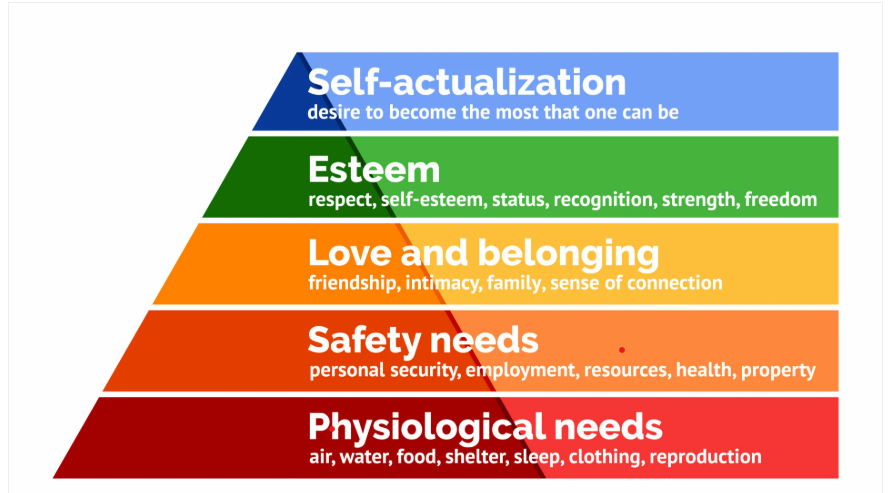
Photo credit: Maslow's Hierachy of Needs (Evans, 2026)
A sense of belonging
Belonging shows up through questions that sit beneath the surface; these can look like:
Am I valued?
Do I feel psychologically safe?
Can I be myself, and do I feel comfortable at work?
Is this a place I want to belong?
Do I have the potential to thrive and succeed here?
Workplace interactions can influence how comfortable someone feels expressing their ideas, perspectives and identity.
In the September 2025 episode of the EZRA Asks Podcast, hosts Oliver Boag and Lewis Michael Baird sit down with Simon Blake, CEO of Stonewall UK, to explore what inclusion looks like at work. Simon shared, "If you’re worried about hiding parts of your identity, your brain is computing that instead of focusing on work".
YouTube short here: Building belonging at work: Inclusive leadership with Stonewall CEO Simon Blake
When the questions asked haven’t moved on
In 2023, my research explored if there was a link between the processes used when recruiting and selecting staff, and the inclusive culture of an organisation. The results suggested that only 70% of participants were aware of their employer’s diversity and inclusion agenda.
While the sample size was small, the insight highlighted how easily organisational intentions can fail to translate into employee experience.
It was clear that belonging begins forming long before someone joins an organisation. Interestingly, organisations frequently communicate inclusion externally through employer branding, yet individuals can sometimes experience something different once they enter the workplace.
In 2025, I conducted research with a larger sample size and asked participants to reflect on which element of PH Creative's Three Cs of employer brand had the strongest impact for talent attraction initiatives; the options included career catalyst, culture, and citizenship.
Career Catalyst was the prominent theme, indicating that proof of career advancement, access to development, challenging work, external reputation, diversity and compensation are the drivers that influence decisions.
Evidence suggested that while organisations emphasise purpose and values externally, many employees still evaluate belonging through everyday organisational behaviour.
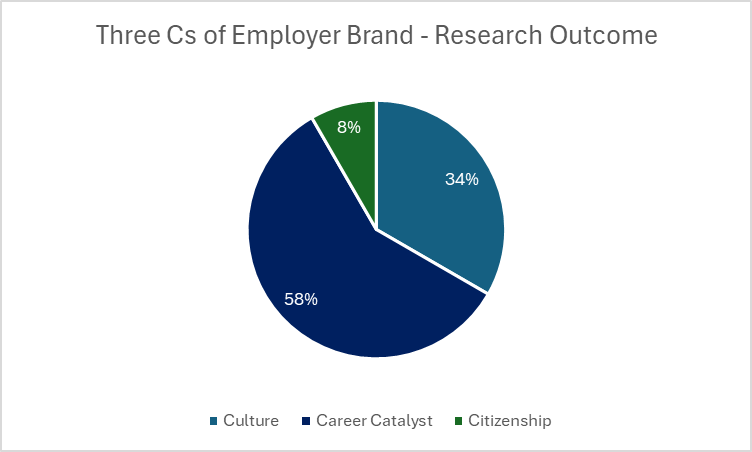
Three Cs of Employer Brand - MSc Research Outcome
Access the article with my research included here
Belonging and risk of groupthink
While belonging can strengthen engagement and commitment, there is also potential tension that organisations need to be aware of.
In some environments, belonging can unintentionally drift towards conformity, where individuals feel pressure to align with dominant views to fit in. When this happens, the desire to belong may begin to outweigh the willingness to challenge ideas or express alternative perspectives.
This dynamic is reflected in the Attraction-Selection-Attrition (ASA) model, introduced by Benjamin Scheider in 1987. The model suggests that individuals are naturally attracted to the organisations whose values and culture resonate with their own. Over time, organisations tend to select and retain people who fit those characteristics, while those who don't feel aligned often leave.
One potential consequence is groupthink, a phenomenon explored by Irving Jarvis in 1971. This is said to occur when well-intentioned groups prioritise harmony and consensus over individual ideas and perspectives.
Recruitment and selection processes can unintentionally reinforce this pattern. As Caldwell (2018) suggests, organisations have emphasised person-organisation fit during hiring decisions. While alignment can support cohesion, it can also lead to organisations hiring individuals with similar perspectives and backgrounds; thus, hiring patterns are evident.
Belonging as a career catalyst
Belonging becomes a catalyst for different reasons. When people feel like they belong, they often show they are engaged and are happy to be an advocate. However, when belonging is absent, it can become one of the signals that encourages people to explore alternative opportunities.
In this way, belonging influences both retention and attrition. The question for Employer Brand and Talent Attraction Leaders:
What signals are you sending about belonging, and does your organisation welcome different perspectives?